How They Made It Work: Low-Pressure Flash
Company
Technology
Low-Pressure Flash (LPF) dryer/conditioner for mechanically dewatered mineral-salt discharge
Development, design and purpose
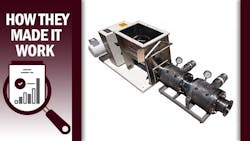
Low-Pressure Flash (LPF) is a compact drying and conveying retrofit developed to handle sticky mineral salts, chelated minerals and other high-purity inorganic salts. Designed to fit into existing process lines, it operates at sub-atmospheric pressure within water's flash zone. As the wet cake enters, a high-velocity air stream entrains the material, removing surface moisture in milliseconds through rapid evaporation. The unit serves as a debottlenecking step, converting sticky, mechanically dewatered discharge into dry, free-flowing powder, which allows for downstream conveying without chronic plugging or frequent cleanouts.
Significance in chemical plants
Many mineral-salt and specialty chemical plants run dewatering-to-drying lines that are bottlenecked by sticky wet cake. When mechanically dewatered discharge plugs dilute-phase lines or chutes, operators spend hours on hazardous cleanouts, and the downstream dryer operates well below its nameplate capacity. A compact LPF unit installed at the wet-cake discharge point dries and conditions the cake, so it behaves like free-flowing salt. By integrating drying, conditioning and conveying in a single, compact unit, LPF enables process intensification. This allows plants to reliably feed existing dryers or downstream processes, debottleneck existing assets, reduce manual cleaning and improve uptime without expanding the footprint.
Unique features
LPF operates in water's flash zone at sub-atmospheric pressure, maintaining system pressure below the vapor pressure of water at the operating temperature. This thermodynamic approach enables moisture removal in milliseconds with minimal thermal exposure, while the high-velocity "air-shield" stream helps prevent smearing or buildup on hot internal surfaces. LPF utilizes evaporative cooling to protect heat-sensitive materials, delivering minimal scaling with extended run lengths in a compact footprint. It can be installed under existing centrifuges or other wet-cake discharge points and tuned for different materials without major changes to downstream processes.
Real-world example
A leading specialty chemical producer of high-purity mineral salts was experiencing chronic plugging in the pneumatic line between a centrifuge and a dryer. The crystallizer produced a fine salt slurry; the centrifuge discharged a sticky wet cake that would bridge in the discharge chute and repeatedly plug the dilute-phase conveying line. Operators had to shut down several times per week, open the line and manually dig out material. The downstream dryer was underutilized because it could not be fed reliably, and maintenance spent significant time cleaning the conveying system and dryer inlet.
Flash Rockwell installed an LPF unit directly under the centrifuge as a compact retrofit. In this service, the LPF conditions the centrifuge discharge immediately, utilizing its air-shield flash zone to remove sufficient surface moisture so that the salt never enters its sticky phase on metal surfaces. The dried salt discharges as a free-flowing powder and is pneumatically conveyed either directly to packaging or to the existing dryer, which now functions primarily as a final thermal/kill step when required.
After startup, the plant reported elimination of pneumatic line plugging. Conveying became stable enough to run the line at the mechanical capacity of the centrifuge rather than being limited by sticky-phase behavior. Operators saw a marked reduction in invasive line cleanouts. The LPF retrofit debottlenecked the train, increased throughput of dried mineral salts, and delivered the required capacity without a large capital project or complex process redesign.
About the Author