Future-Proofing Chemical Engineering Education
3 Key Takeaways
- Chemical engineering education must evolve to integrate substantial industry-practical experience into academic training.
- Degree apprenticeships represent a critical pathway for developing workforce-ready professionals with real-world skills.
- Collaborative models between academic institutions and industrial partners are essential for preparing next-generation chemical engineers.
Keeping chemical engineering curriculum relevant and up to date requires extensive interaction between academics and industry — a process that demands time, effort, goodwill and often finance.
“We need much more focus on curriculum delivery,” said Jarka Glassey, professor of chemical engineering and director of education at Newcastle University’s school of chemical engineering in the U.K. “I look at all our engineering courses, and one thing I insist on right at the start is that industry needs to be engaged in all the modules.”
Glassey has a long-standing involvement with the Institution of Chemical Engineers (IChemE)’s education subcommittee and is an executive member of the European Federation of Chemical Engineering’s working party on education. These organizations work closely with manufacturers to identify knowledge, skills and attitudes required by graduates to prepare them for the workforce.
Some of the latest curriculum changes include an emphasis on digitalization, ethics and responsible engineering, including sustainability, Glassey noted. Also, joint IChemE workshops with industrial partners have helped identify important knowledge requirements and the development of resources to support their delivery.
“Interaction makes such a big difference,” she suggested. “For example, we had an industrialist talking to the students about thermodynamics. It showed the practical application of what is regarded as a difficult and dry subject. If industry can provide us with resources, such as data and some challenges the industry faces, it means we can get the students solving real industrial problems. It’s also good for the company involved because they get to interact with potential future workers and get their name known.”
One problem, however, is that such interactions tend to be ad hoc, she cautioned, adding that there must be a structured approach to connecting graduates with companies.
This is why IChemE and other engineering accreditation organizations in the U.K. and Europe are pushing to improve industrial collaboration by establishing advisory bodies of industrialists who can provide input into shaping curriculum content by highlighting new and evolving skills requirements.
On the other hand, Glassey suspects the percentage of academics who have industrial experience is falling in the U.K. and likely across Europe.
One reason for this is that their own research often is focused on more advanced and niche areas of chemical engineering rather than core topics. Another is that academic funding and progress are influenced by research output, so there is little incentive to take an industrial placement, which might involve confidential and, therefore, unpublishable research.
“I’d hazard a guess that take up of industrial placements is low and falling,” said Glassey.
The impact of new technologies poses a challenge for educators, too.
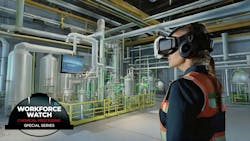
For example, Glassey’s own career has revolved around machine learning and artificial intelligence, and her department has just completed an European Union-funded project on using virtual reality (VR) as a training tool.
“We have shown that the training in a photorealistic VR pilot plant environment is transferrable to real pilot plants, opening opportunities to lower capex on physical facilities,” she explained.
But the cost of VR technology is a barrier for training purposes, Glassey acknowledged, adding that her department could only acquire a small number of VR sets to use with students.
Dow Chemical’s Curriculum Approach
For Dow, conferences and regional meetings present opportunities to engage with students and identify how their skills can meet the company’s expectations.
“Through these interactions with students as well as other academics, we are able to gauge their ability to solve multiple types of problems in addition to effectively managing stakeholders across the R&D function,” said Jill Martin, the company’s global sustainability fellow.
Company experts often attend advisory board meetings for university partners and offer their feedback on curriculum across the science and engineering disciplines.
Getting new subject material approved requires continuous dialogue with advisory boards and engagement between department chairs and college deans or provosts to ensure alignment with the university’s broader objectives, Martin explained.
Dow also collaborates with many universities on company-sponsored research programs and government-funded projects.
“These programs offer students firsthand experience in tackling industrial challenges and receiving mentorship from Dow scientists and stakeholders,” Martin said. “This helps them develop soft skills, such as team collaboration, effective communication and project management, which are all critical to a successful career in industry.”
Dow also encourages staff to share their knowledge with students, including teaching opportunities.
“Certain groups develop specialized short courses that our scientists teach at various universities on a regular basis,” Martin shared. “For instance, our engineering and process science group has taught a reaction engineering short course at a dozen universities over the past several years.”
Unlike the research hurdles faced by U.K. academics, Dow collaborates with many universities on specific projects with expectations that the work will be published.
“This helps enable the faculty to continue their route to tenure. This is managed through agreements at the project inception,” Martin explained.
Dow also provides access to its technology capabilities to academic partners, providing they are primarily benefitting Dow.
“We also encourage our collaborators to apply for additional grants, so that the capability development can be broadly used thereby bringing more research dollars to the universities,” Martin elaborated. “We often collaborate on government-funded research to better address that objective.”
Various internship opportunities exist, as well. For example, Dow’s 2025 Advanced Digital Internships for Scientists and Engineers program focuses on R&D, information systems, commercial, toxicology and environmental research and consulting, plus supply chain and operations.
Check out More from our Workforce Watch Series
"Chemical Industry Workforce: Shaping Tomorrow's Talent" features a series of in-depth articles on the state of the chemical industry workforce and its future. Read more by clicking on the links below.
- Deconstructing the Chemical Industry’s Skills Gap
An aging workforce, fierce competition for graduates and culture clashes: Inside the chemical industry's struggle to fill critical roles. - Diversity Isn’t a Dirty Word
BASF and Suncor buck the trend of ditching DEI programs proving they are tied to innovation and success. - Operator Training: Tap New Ways to Boil Down Experience
With the right tools, training is just condensed experience. - Chemical Processing's 2024 Job Satisfaction and Salary Survey Results
Annual survey reveals continued positive job outlook and earnings despite a dip in hiring.
AIChE Interactions
Similar to to IChemE’s efforts, the American Institute of Chemical Engineers (AICheE) is actively involved in training and education through its Education Services Department, Institute for Learning and Innovation (ILI) and its education and accreditation (E&A) committee, among others.
The chair of AIChE’s E&A committee and its executive director invited a group of members active in AIChE’s education efforts to discuss with us how new topics and technologies are integrated into course programs, the interactions between educational institutions and industry, and how real-life events influence curriculum content.
The group is made up of: Rukyah Hennessey, director of the AIChE Education Services Department; Wendy Young, who has held many leadership positions in AIChE related to career and education, including the board of directors and senior director of the ILI, and now serves as business development manager for OLI Systems; Tom Spicer, professor in the chemical engineering department at the University of Arkansas; David L. Silverstein, chair and professor in the University of Mississippi’s chemical engineering department; and Alon McCormick, professor of chemical engineering and materials science at the University of Minnesota.
The AIChE E&A committee organizes volunteers' efforts to work with ABET, the organization responsible for accrediting college and university programs. The committee reports to the AIChE board of directors and executive director through its Career and Education Operating Council.
Integrating Trending Topics and Technologies into Courses
Curriculum requirements for courses are specified in criterion five of ABET’s accreditation criteria. The group emphasizes that these define the minimum requirements and do not necessarily include the most current, state-of-the-art topics.
These usually find their way into the curriculum through incorporation into new textbooks, elective courses, conference education programming, such as at the AIChE annual meeting with its education division, and through the AIChE ILI and its webinars on cutting-edge topics.
The ILI’s 2024 summer camp, for example, included broad topics of data engineering, process safety, sustainability and professional development. Within these categories, attendees had a diverse selection of potential courses, including:
- studying for the new Center for Chemical Process Safety (CCPS) fundamentals certificate program,
- assessing sustainability with metrics and methods,
- taking an introduction to data science with Python,
- and a review of professional ethics.
Educational Institutions and Industry Interactions
Criterion six of ABET’s accreditation criteria mandates professional development and faculty interactions with students and industrial practitioners.
“Most institutions include industry as a core constituency and involve members at least on their advisory boards if not also in more direct ways. Similarly, levels of activity with industrially aligned projects and consulting roles vary greatly across institutions and amongst individual faculty members,” the group noted.
The ILI also promotes interactions with students and industrial partners through programs such as its Risk-Based Process Safety Student Boot Camp and Risk-Based Process Safety Faculty Workshop. Here, seasoned industry professionals introduce practical process safety training to students and faculty.
However, the group acknowledges that the level of industry connection varies from institution to institution.
For example, some universities do very well in establishing boilerplate intellectual property agreements that require only routine work to establish industrial collaboration. In cases where sponsored industrial research through the university is welcomed, there has typically been considerable effort to establish the university’s legal position to make this effective.
“Other universities require ad hoc and often difficult processes, perhaps leading to agreements but sometimes to abandoning the attempt. Confidentiality can be a challenge for evaluation for promotion and tenure. The ability of programs to address these concerns vary widely,” the group noted.
The Influence of Real-Life Events on Curriculum
Nevertheless, events can and do influence curricular content.
For example, in December 2007, a blast at T2 Laboratories in Jacksonville, Florida, led to four deaths and 14 injuries. The company primarily specialized in the manufacture of specialty chemicals for use as additives in gasoline.
The explosion occurred in a 9500 L batch reactor manufacturing an anti-knock agent when the cooling system failed. The subsequent Chemical Safety and Hazard Investigation Board report concluded that the company owners, a B.S.-level chemist and a B.S.-level chemical engineer, were unaware of the potential for a runaway exothermic reaction and under-designed the cooling and relief systems.
The report cited a lack of training as the root cause and recommended that ABET work with AIChE “to add reactive hazard awareness to baccalaureate chemical engineering curricula requirements”.
This was taken up by the AIChE’s Safety and Chemical Engineering Education (SAChE) committee and its E&A committee.
The SAChE committee developed a detailed response, with several recommended changes to the ABET chemical engineering program criteria that were very detailed. The E&A committee considered these, ultimately deciding to recommend that the program criteria be changed, specifically adding the phrase “including the hazards associated with these processes” relating to the “design, analysis and control of processes.”
This wording was chosen to avoid the issue of being overly restrictive to programs.
The group notes that required chemical process safety content in the curriculum involves discussing incidents relevant to chemical process safety, while SAChE training modules are used as supplemental materials to fill in curriculum gaps around process safety training.
“We do not know of any incidents since T2 that have so clearly changed curriculum guidance, and there have not been more recent pushes from government affiliated agencies. Of course, there are always emerging topics that are of interest and impact to chemical engineering education, but each program has the autonomy to integrate these topics as it sees fit,” the group added.
Education Versus Training
While Glassey believes the best way to prepare graduates for their working life is in partnership with industry, she stressed that education and training are fundamentally distinct.
“There is a difference between education and training. Engineering degrees should be educating engineers and business leaders ready to face the future challenges that we are not even aware of yet, not just able to solve current problems, using current tools — something that industrial practice and internships in real industry environment are best placed to provide,” she suggested.
Hence, innovative educational approaches such as degree apprenticeships with a significant practical element are crucial for training the next generation of chemical engineers, she emphasized.
“Remember, too, that it also takes time and effort to keep up industrial links,” she advised. ⊕
About the Author
 Seán Ottewell
Seán Ottewell
Editor-at-Large
Seán Ottewell is a freelance editor based in Ireland. He has an impressive background in the chemical industry. After earning his degree in biochemistry at Warwick University, UK, he earned his master's in radiation biochemistry from the University of London. His first job out of school was with the UK Ministry of Agriculture, Fisheries and Food, London, where he served as scientific officer with the food science radiation unit.
From there he entered the world of publishing. In 1990, he was the assistant editor of The Chemical Engineer, later moving on to the chief editor's position. Since 1998, he has been a regular contributor to European Process Engineer, European Chemical Engineer, International Oil & Gas Engineer, European Food Scientist, EuroLAB, International Power Engineer, published by Setform Limited, London, UK.
Chemical Processing has been proud to call Ottewell Editor at Large since 2007.
He and his family run a holiday cottage in the small village of Bracklagh in East Mayo. He also fancies himself an alpaca farmer.